

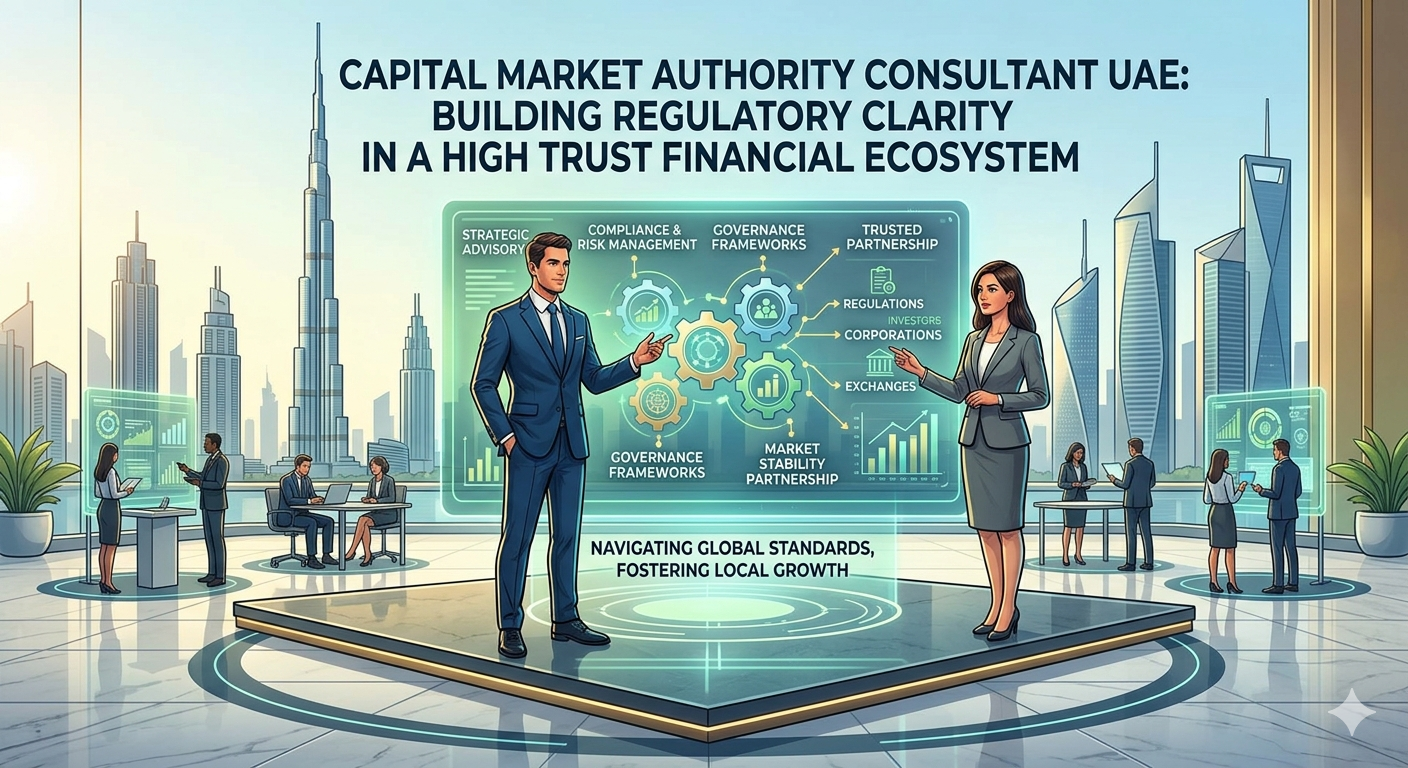
Capital Market Authority Consultant UAE
In the United Arab Emirates, capital markets operate within a highly structured regulatory environment governed primarily by the Securities and Commodities Authority (SCA). For financial institutions, investment firms, fintech companies, brokers, and asset managers, compliance is not a secondary function. It is the foundation of market access, operational continuity, and investor trust.
At Keepers Compliance, we work as a capital market authority consultant in the UAE, supporting organizations in interpreting, implementing, and sustaining SCA regulatory obligations with precision and strategic alignment. We do not treat compliance as a checklist. We treat it as an operating architecture that defines how financial businesses function, scale, and survive regulatory scrutiny.
This blog explores a unique lens on SCA consulting in the UAE, focusing on how regulatory frameworks shape business design rather than simply restrict it.
Understanding the SCA Landscape as an Operating System, Not a Rulebook
Most firms approach the Securities and Commodities Authority as a licensing authority that issues approvals and enforces rules. That view is incomplete.
The SCA functions more like a regulatory operating system that governs:
• Market entry and licensing architecture
• Conduct of financial intermediaries
• Investor protection mechanisms
• Disclosure and reporting standards
• Anti money laundering alignment within capital markets
• Product structuring rules for securities and commodities offerings
From our perspective at Keepers Compliance, the most successful firms in the UAE are those that design their internal systems around SCA logic rather than retrofitting compliance after business formation.
This is where a capital market authority consultant in the UAE becomes essential, translating regulatory language into business structure.
Why Capital Market Compliance in the UAE Requires Specialized Interpretation
The UAE financial ecosystem is unique because it combines:
• Federal level regulation through SCA
• Free zone regulatory frameworks in financial hubs
• Cross border investor participation
• Rapid fintech and digital asset evolution
• Multi jurisdictional compliance expectations
This complexity creates a gap between regulatory intent and operational execution.
A direct reading of SCA rules is not enough. The real challenge lies in interpretation layers such as:
• How licensing categories overlap with actual business models
• How investment advisory definitions apply to digital platforms
• How custody and brokerage boundaries are enforced in practice
• How marketing financial products is regulated across jurisdictions
At Keepers Compliance, we focus on bridging this interpretation gap so that compliance becomes actionable rather than theoretical.
Licensing Strategy as a Foundational Capital Market Decision
One of the most overlooked aspects of SCA compliance is licensing strategy.
Most firms treat licensing as a formality. In reality, it determines:
• Revenue model feasibility
• Permitted financial activities
• Capital requirements and governance obligations
• Scope of client engagement
• Long term scalability within UAE markets
A capital market authority consultant in UAE must evaluate licensing not just as an application process but as a strategic business architecture decision.
At Keepers Compliance, we assist clients in aligning their licensing category with their actual operational intent, reducing future regulatory friction and restructuring risk.
Designing Compliance Architecture for SCA Regulated Entities
Compliance is often misunderstood as documentation and reporting. In reality, it is a structured internal system consisting of governance, controls, and monitoring frameworks.
We help organizations design compliance architecture across four core dimensions:
1. Governance Framework Design
Defining board level oversight, compliance accountability, and decision escalation pathways.
2. Operational Compliance Integration
Embedding compliance checkpoints into trading, advisory, onboarding, and transaction workflows.
3. Risk Classification Systems
Building internal models for identifying, scoring, and escalating financial and regulatory risk.
4. Regulatory Reporting Infrastructure
Ensuring accurate, timely, and audit ready submission of SCA required reports.
This approach ensures compliance is not dependent on individuals but built into the organization itself.
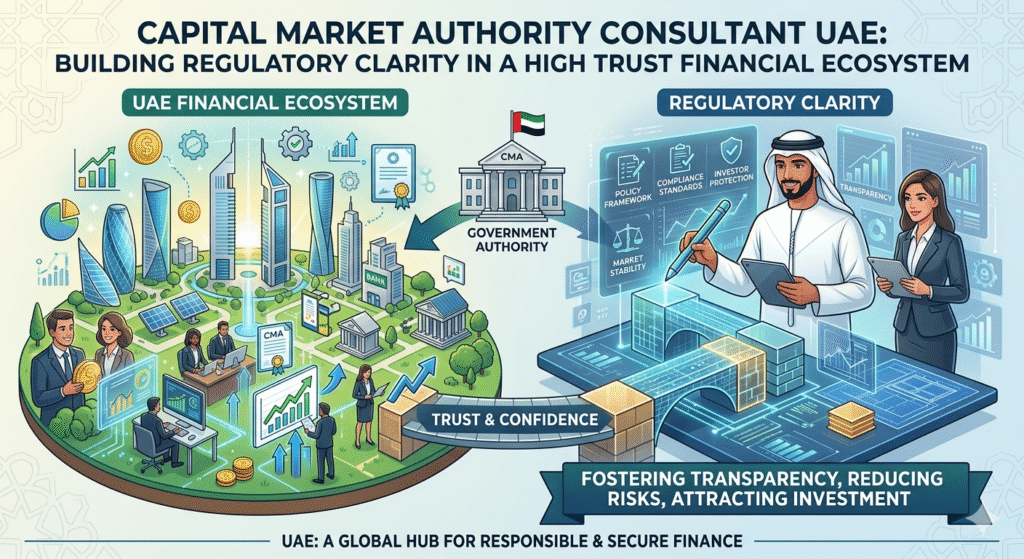
SCA Compliance in a Digitally Transforming Financial Market
The UAE capital markets are undergoing rapid transformation driven by:
• Digital brokerage platforms
• Robo advisory systems
• Tokenized securities and digital assets
• Algorithmic trading models
• Cross border fintech integration
These innovations create regulatory ambiguity because traditional SCA frameworks were designed for conventional financial intermediaries.
A modern capital market authority consultant in UAE must interpret how legacy regulations apply to digital-first models.
At Keepers Compliance, we focus on regulatory mapping for innovation, helping firms understand:
• Whether digital advisory models fall under investment advisory licensing
• How custody rules apply to tokenized assets
• How automated trading systems must be governed
• What disclosure requirements apply to platform based investing
This ensures innovation does not move outside regulatory boundaries.
Anti Money Laundering Alignment Within Capital Markets
AML compliance is deeply integrated into SCA expectations, particularly for entities handling:
• Investor onboarding
• Fund flows
• Cross border investments
• Brokerage operations
• Asset management structures
However, AML within capital markets is not identical to banking AML frameworks.
It requires:
• Transaction behavior analysis specific to trading environments
• Investor classification and risk profiling
• Market manipulation detection controls
• Suspicious activity reporting tailored to securities flows
We help organizations align AML systems with capital market realities rather than generic financial compliance templates.
Regulatory Risk as a Strategic Business Variable
In many firms, regulatory risk is treated as a compliance department concern. In reality, it is a strategic business variable that influences:
• Market expansion decisions
• Product development cycles
• Investor acquisition strategies
• Technology adoption
• Cross border structuring
A capital market authority consultant in UAE must help leadership teams understand that regulatory risk is not external to business strategy. It is embedded within it.
At Keepers Compliance, we work closely with executive teams to translate regulatory constraints into strategic planning inputs.
The Role of Keepers Compliance in the UAE Capital Market Ecosystem
As a capital market authority consultant in UAE, Keepers Compliance focuses on delivering clarity in environments where regulatory interpretation directly impacts business viability.
Our approach is built on three principles:
Precision in Interpretation
We decode SCA requirements into operational language that businesses can implement.
Structural Compliance Design
We build compliance systems that function at scale, not just at onboarding stage.
Long Term Regulatory Alignment
We ensure that firms remain compliant as regulations evolve, not just at the time of licensing.
Final Perspective: Compliance as Market Identity
In the UAE capital markets, compliance is not separate from identity. It defines how a firm is perceived by regulators, investors, and counterparties.
Organizations that treat SCA compliance as a strategic design discipline rather than an administrative requirement gain a significant advantage in credibility, scalability, and operational resilience.
At Keepers Compliance, we believe the future of capital market participation in the UAE belongs to firms that build compliance into their foundation, not those that retrofit it later.
Our role is to make that foundation clear, structured, and sustainable.